It's finally Friday, and what a week it's been. Have you ever looked at someone and thought, “Who taught you shapes?” My fave line from that flick, by the way, so bonus points if you get the connection with this one.
There is a lot happening in the world today, and it really just seems to pile up. It can be scary out there. Everyone is in such a hurry, insta-solution Tiktok remedy style life. They tend to forget the human touch in life.
Day #23 of 31 Days of Halloween
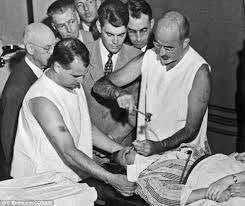
In the 1950s-1960s an American neurologist named Walter Freeman packed his station wagon, which he casually dubbed the lobotomobile, and drove across the country to perform assembly line brain surgeries at overcrowded state mental hospitals.
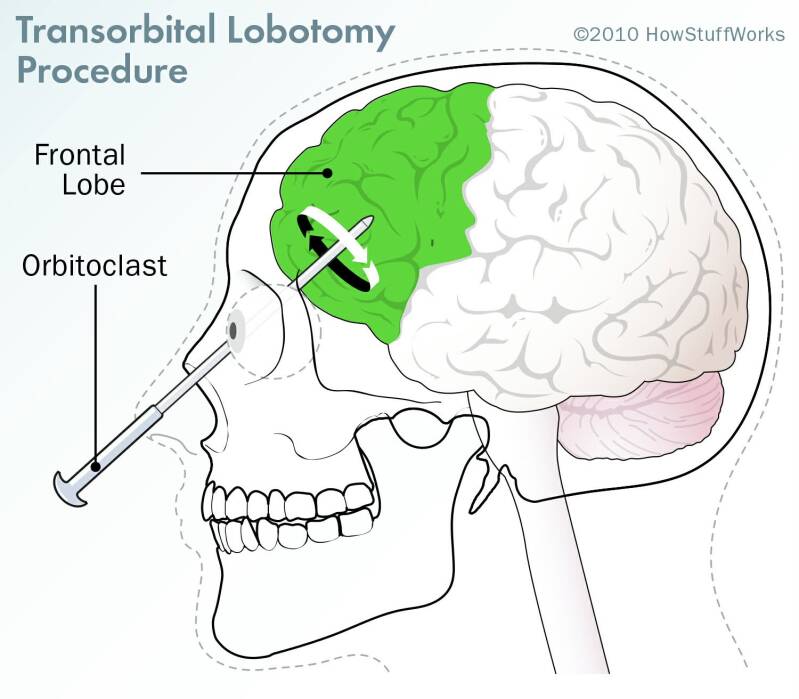
He was the creator of the transorbital icepick lobotomy, a crude procedure meant to slice through the frontal lobes without needing a sterile surgical theater or a proper scalpel.
His favorite tool was a sharp steel icepick pulled straight from his kitchen drawer.
Patients were strapped down to stained vinyl examination tables and hit with massive electroshock currents that sent their limbs into violent, involuntary spasms until they passed out.
Without washing his hands, slipping on sterile gloves, or wearing a mask, Freeman walked over to the twitching patient, pulled back the upper eyelid, and resting the sharp tip of the heavy metal spike against the paper thin bone of the eye socket directly above the eyeball.
With a few hard whacks of a wooden mallet, he drove the cold steel straight through the eye socket and deep into the warm, squishy tissue of the living brain.
Once the spike sank three inches inside the head, Freeman grabbed the handle and forcefully swished it back and forth like a blender blade, severing nerve pathways and ripping through soft brain matter.
The sound inside the skull was a muffled squelch as the steel pulverized living tissue.
Because he worked blindly, the steel rod routinely ruptured major blood vessels and tore through the delicate membranes surrounding the brain.
Dark, venous blood mixed with yellowish cerebrospinal fluid immediately bubbled up from around the eyeball, flooding the socket and running down the patient’s cheeks in thick, sticky streams.
Freeman then wiped the bloody icepick off on his coat or a dirty napkin and jammed it directly into the other eye socket to finish the job.
Patients regained consciousness in pools of their own blood, vomit, and spilled spinal fluid, their faces swollen beyond recognition and both eyes bulging, blackened, and bruised a deep rot like purple.
Liquefied fat and shredded muscle tissue from behind the eye socket leaked out of the corners of their eyelids and dripped out of their nostrils.
Inside the crushed skull cavity, the torn brain tissue quickly starved of oxygen, turning into a foul, greyish-yellow necrotic mush that pooled in the floor of the skull as the body desperately tried to reabsorb its own liquefied organs.
Dozens of patients suffocated on their own blood or died on the gurney as their brains flooded with hemorrhages, while thousands more were left drooling, incontinent, and permanently brain damaged, walking around with pulverized, rotting frontal lobes for the rest of their lives.
In our obsessed culture of rapid biohacks and instant dopamine fixes, Freeman’s lobotomobile was the ultimate fast-food culture cure, proving that when society demands a ten minute shortcut for complex human suffering, we are all too willing to line up and let someone stir our brains into a lukewarm bucket of grey, mushy slop just to feel nothing at all.
Interesting tidbit no one asked for? Walter Freeman II practiced until 1968, when he performed a 3rd round lobotomy on a patient, Helen Mortenson. He performed over 3500 surgeries, even though he had no surgical training or licensing. Lobotomies were phased out shortly after his death in 1972, thanks to evolutions in mental health and medications.
Freeman is often still cited in intro courses at local universities. He was listed on one of my professor's (BPNS/Psyc 102) syllabi in 2009.
Add comment
Comments